

In the winding mountain passes of the Himalayas, there is a sound that defines the very essence of “Auspiciousness.” It is the sharp, melodic cry of a Sahanai over a deep, thumping bass—a sound that announces to the gods and the neighbors alike that a life-changing ceremony is underway.
This is the Panche Baja, the “Five Musical Instruments,” and it is the most important musical ensemble in Nepali culture. To understand Panche Baja is to understand the rhythmic DNA of the Nepali people.
1. The Alchemy of Five: Philosophy and Craft
The name “Panche Baja” is deeply rooted in Hindu and Buddhist philosophy. It represents the Pancha Tatwa (the Five Elements: Earth, Water, Fire, Wind, and Sky). Traditionally, the instruments are crafted using Pancha Dhatu, a sacred alloy of five metals: gold, silver, copper, iron, and lead.
The ensemble is a perfectly balanced acoustic system:
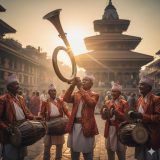
- Sahanai (The Spirit): A double-reed woodwind instrument similar to an oboe. It is the only melodic instrument in the set. The lead musician, often the most skilled member of the group, uses it to mimic human vocals, playing tunes that range from heart-wrenching Bidai (departure) songs to jubilant wedding marches.
- Damaha (The Heartbeat): A large, hemispherical kettle drum made of copper and covered with buffalo hide. It provides the “bass” of the ensemble. Musicians often keep a small amount of water inside the drum to maintain the humidity of the leather, giving it a deep, resonant “oomph” that can be felt in the chest.
- Tyamko (The Pulse): A tiny kettle drum, about the size of a bowl, tied to the musician’s waist. It is played with two small sticks (gajo) and provides the high-tempo “click” that drives the rhythm forward.
- Dholaki (The Swing): A double-headed drum that adds a rhythmic swing and “fill” to the music, ensuring the beat is never static.
- Jhyali/Jhyamta (The Energy): Bronze cymbals that provide the “clash” and “shimmer.” They represent fire and energy, keeping the dancers’ feet moving.


2. The Guardians: The Legacy of the Damai Community
For centuries, the art of Panche Baja has been the exclusive heritage of the Damai community. Within the traditional social structure of Nepal, the Damai were not just tailors but also the village’s master musicians.
Their role is considered Shuva (highly auspicious). No marriage, coronation, or religious festival (Jatra) is considered spiritually “sealed” until the Damai ensemble performs. This creates a fascinating cultural paradox: while the community faced social challenges historically, they were—and are—the essential gatekeepers of Nepal’s joy and spiritual rituals.
3. From Five to Nine: The Naumati Baja
For those who want to announce their celebration to the next valley over, there is the Naumati Baja (The Nine Instruments). This is the “Grand Orchestra” version of the Panche Baja. It includes:
- Two Sahanais (for polyphonic harmony)
- Two Damahas (for massive bass volume)
- The Narsingha: A spectacular, C-shaped copper trumpet that can be nearly 7 feet long. It doesn’t play melodies but produces a deep, booming roar that signals the groom’s arrival like a royal fanfare.
4. The Niche List: The Rhythms of Life
Panche Baja isn’t just “folk music”; it is a set of specific “Event Codes.”
- The Mangal Dhun: The “Auspicious Tune” played at the very beginning of any ceremony to invite the gods.
- The Bidai Dhun: A slow, mournful melody played when the bride leaves her parental home. It is designed to make the audience weep.
- The Janti Dhun: A high-energy, fast-paced rhythm played as the groom’s procession (Janti) walks through the streets.
The Essential Panche Baja Playlist
If you want to experience the true vibe of a Nepali hill wedding, these are the essential melodies to listen to:
- “Resham Firiri” (Panche Baja Version): The unofficial national anthem of Nepal sounds completely different when played on the Sahanai.
- “Asare Mahinama”: A classic folk tune often adapted for the ensemble during the monsoon planting season.
- “Beni Bajar”: A high-energy dance track that is a staple at every modern wedding. Watch/Listen here
- “Gham Dubyo Dadaima”: A beautiful, soulful melody perfect for an evening celebration. Watch/Listen here
- “Machha Mitho Asala”: A rhythmic favorite that gets everyone on the dance floor. Watch/Listen here
Final Verdict: Why This is the “Post of the Day”
Panche Baja is more than just a musical performance; it is a “Living Museum.” In an era of digital music and globalized pop, these five instruments continue to protect the unique cultural identity of Nepal. Whether you are a music lover, a traveler, or a history buff, the Panche Baja is the ultimate soundtrack to the soul of the Himalayas.